
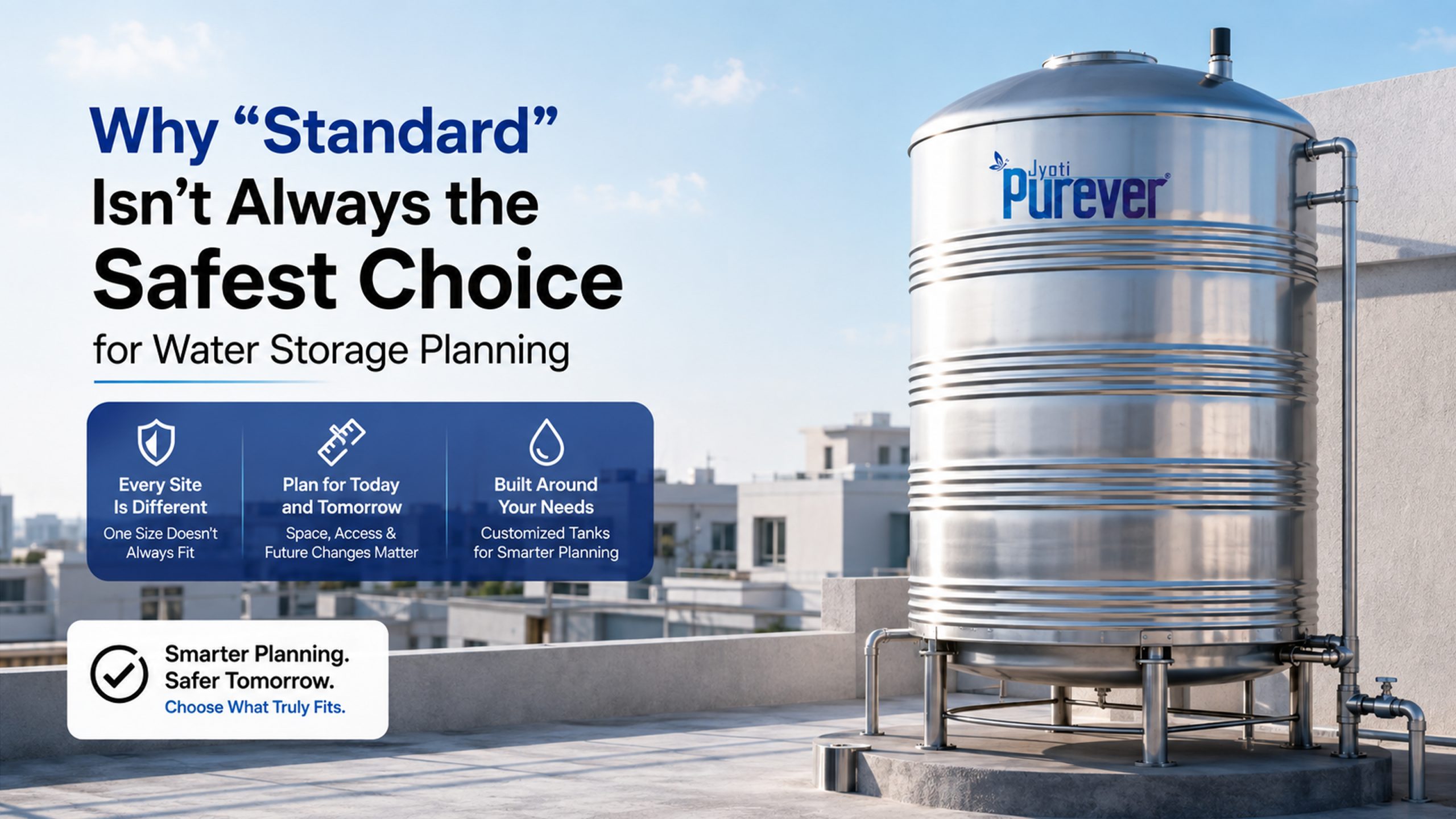
The Drawing Said It Would Fit
A contractor once described a situation that probably sounds familiar to anyone who has spent time around a construction site.
The water tank had already been selected. The capacity was right. The dimensions looked fine on the drawing. Everything seemed straightforward.
Then the actual installation began.
A pipe route had shifted slightly. A structural element took up more usable space than expected. Access around the tank became tight, and what had looked like a simple installation turned into a series of adjustments.
The tank wasn’t necessarily the problem.
The assumption was.
Standard products are designed to work in standard conditions. Buildings, unfortunately, don’t always cooperate with that idea. Every site has its own awkward corners, space restrictions, plumbing layouts and future plans. Sometimes a standard option works perfectly. Sometimes it creates compromises that nobody notices until the building is already occupied.
That’s why water storage deserves a little more thought than simply matching capacity with a product catalogue.
A “Standard” Tank Is Built for an Average Situation
And there is nothing wrong with that.
The issue begins when an average solution is forced into a site that isn’t average at all.
A residential villa with an irregular rooftop layout has different requirements from an apartment building. A commercial property may have limited installation access. An industrial facility may need a storage arrangement that works alongside machinery, pipelines and future expansion plans.
On paper, all of them need water storage.
In reality, the planning behind that storage can be completely different.
This is where Customized steel water tanks become useful. Instead of asking how a building can accommodate an existing product, the conversation starts with the available space and the requirements of the property itself.
It’s a more practical way to approach infrastructure that is expected to remain in place for years.
The Problems Usually Don’t Appear on Day One
That’s part of what makes poor planning difficult to spot.
A standard tank can be installed successfully and perform well initially. Water is being stored. The pumps are working. Nobody has a reason to complain.
The difficulties often show up later.
Someone needs to clean the tank and realises access is restricted. Additional equipment is installed nearby, leaving even less working space. Water demand changes as the building’s usage changes. A repair that should have been routine takes longer because the original layout makes it difficult to reach important connections.
None of these issues necessarily require an immediate replacement.
People adapt.
And sometimes that ability to adapt hides the fact that the system could have been planned better from the beginning.
Thoughtfully designed Customized Stainless steel water tanks can reduce some of those compromises by taking the actual site conditions into account before installation.
Space Isn’t Just About What Fits Today
One mistake people make during construction is assuming that unused space will remain unused.
It rarely does.
A rooftop that appears spacious during the early stages of a project may eventually accommodate solar panels, air-conditioning equipment, plumbing lines or other services. Commercial properties can expand. Residential buildings may add another floor or change how certain areas are used.
Suddenly, the tank placement decided years earlier becomes part of a much bigger puzzle.
A properly planned storage system doesn’t need to predict every future change. Nobody can do that. It simply needs to avoid making obvious future changes unnecessarily difficult.
That’s one reason Customized SS water tanks can be worth considering for projects where space is unusual or long-term requirements are likely to evolve.
Customisation isn’t about adding complexity for the sake of it.
Sometimes, it’s just good planning.
The Maintenance Team Usually Has a Different Opinion
Ask someone selecting a tank what matters most, and capacity will probably come up first.
Ask the person responsible for maintaining it five years later, and the conversation changes.
They’ll mention cleaning access. They may talk about valves that are difficult to reach or working space that disappeared after other equipment was installed. These aren’t glamorous details, so they can easily be ignored during construction.
But buildings are maintained for much longer than they are built.
That makes those details important.
Well-designed Customized steel water tanks and Customized Stainless steel water tanks allow practical requirements to be part of the original discussion instead of becoming problems for someone else to solve later.
Safer Planning Often Means Fewer Assumptions
Choosing a standard product isn’t automatically a bad decision.
The real question is whether the product actually suits the project.
If the available space is straightforward, the water demand is predictable and future changes are unlikely, a standard option may work perfectly well. But when the site has unusual dimensions, restricted access or specific operational requirements, forcing everything to fit around a standard design can create risks that aren’t obvious at first.
That’s where Customized SS water tanks offer a different approach.
Purever works with the practical realities of the project – space, capacity, layout and long-term usage, rather than treating every installation as identical.
A water tank is easy to overlook because most of its work happens quietly in the background.
But good infrastructure planning often works the same way. You don’t notice it every day.
You notice it years later, when nothing needs to be fixed.